
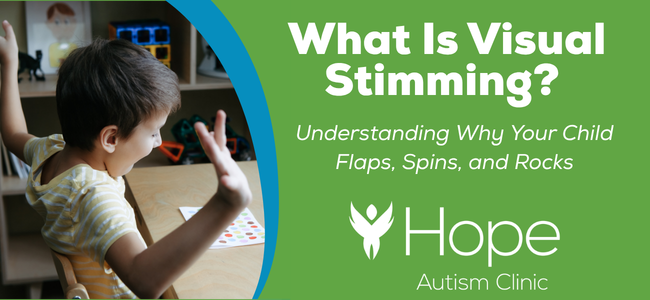
You’re at the grocery store. Your child starts flapping their hands and rocking back and forth in the cart. Other shoppers glance over. You feel the urge to stop it. But then you wonder: Should I? What is this even about? What you’re seeing is called visual stimming, and it’s one of the most common behaviors parents of children with autism notice first.
If you’ve asked yourself why your child does this, you’re not alone. And the answer matters more than most people realize.
What Is Stimming?
“Stimming” is short for self-stimulatory behavior. It refers to repetitive movements or sounds a person uses to regulate how they feel. Almost everyone stims to some degree. Tapping a foot. Twirling a pen. Chewing the inside of a cheek when anxious. For children with autism, stimming often looks more noticeable and happens more frequently.
The most common forms of stimming in children with autism include:
Visual stimming involves behaviors centered on what a child sees or how their body moves through space. This includes hand-flapping, finger-flicking in front of the eyes, spinning objects, watching wheels turn, or moving their own body in circles.
Auditory stimming involves sounds such as humming, repeating words or phrases, tapping surfaces, or covering and uncovering the ears.
Tactile stimming involves touch, such as rubbing a particular texture, scratching surfaces, or pressing the fingers into the skin.
Oral stimming involves the mouth, like chewing on clothing, mouthing objects, or making repetitive mouth sounds.
This blog focuses mainly on visual stimming since hand-flapping is one of the first behaviors parents tend to notice. But it helps to know that stimming comes in many forms, and each serves a purpose for your child.
Why Do Children with Autism Stim?
The short answer: it helps them.
Children with autism often experience the world more intensely than neurotypical children. Sounds can feel louder. Lights can feel brighter. Social situations can feel overwhelming. Transitions can feel jarring. Stimming is one of the main ways their nervous systems cope.
Here are the most common reasons a child might stim:
To manage sensory overload. When the world feels like too much, stimming helps regulate the nervous system. A child who is overwhelmed in a busy environment may flap their hands or spin to help process all that input.
To express emotion. Many children with autism find it hard to express feelings through words or facial expressions. Hand-flapping is often a sign of excitement, happiness, or anticipation. If your child flaps when they see their favorite show come on, that’s joy. Pure and simple.
To cope with anxiety or stress. Stimming can act as a self-soothing tool. A child waiting for something unpredictable or uncomfortable may stim to manage that internal tension.
To focus. Some children stim as a way to block out distractions so they can concentrate. What is can often be mistaken as a distraction may actually be helping them stay on task.
Because it feels good. Sometimes there’s no deeper meaning. The movement or sensation is simply pleasurable. That’s a valid reason too.
What Does Hand-Flapping Actually Look Like?
Hand-flapping is one of the most recognized forms of stimming in children with autism. A child may flap their hands quickly at their sides, in front of their face, or out to the sides of their body. It often happens when they are excited, happy, anxious, or overwhelmed.
Another way visual stimming may manifest is through finger flicking. This is where a child rapidly moves their fingers in front of their eyes, often while looking at a light source. You might also observe your child spinning, rotating their body over and over again, sometimes for extended periods. These behaviors belong to the same family and serve similar purposes.
A helpful way to think about it: your child has found something that works for them. Hand-flapping is a tool they’ve built over time because it helps their body feel better in some way.
Should You Try to Stop It?
This is the question most parents wrestle with, and there’s no single right answer.
Most of the time, stimming is harmless and should not be interrupted. When your child flaps their hands out of joy, stopping that behavior takes something away from them. It can communicate that their natural way of expressing happiness is wrong. Over time, that message does real damage to a child’s sense of self.
Stimming also serves a real function. If it’s helping your child regulate their emotions or manage sensory input, removing it without providing another tool can make things harder, not easier.
That said, there are situations where redirection makes sense:
If the behavior causes physical harm. Some forms of stimming, like head-banging or hitting oneself, can injure a child. In those cases, it’s appropriate to work with a professional to find a safer alternative that meets the same need.
If it consistently prevents learning or daily function. If a child’s stimming makes it hard for them to engage in activities that matter for their development, that’s worth exploring further.
If the child wants help managing it. Older children sometimes become aware that certain stims draw unwanted attention. If your child is distressed by this and wants support, helping them find alternatives they feel good about is appropriate.
The goal is never to eliminate stimming. It’s to understand it and, when truly necessary, offer safer or more flexible options.
How to Respond in the Moment
When you see your child stimming, the first step is to observe, not intervene. Ask yourself:
- What was happening right before this started?
- Does my child seem happy, anxious, overwhelmed, or excited?
- Is this causing any harm?
That information tells you a lot about what your child needs. A child who flaps during a crowded event may need a quieter space. A child who flaps out of excitement may just need room to feel that joy.
Avoid telling your child to “stop” or “calm down” without understanding what’s driving the behavior. Respond to the feeling behind it. If they’re excited, share in that excitement. If they’re overwhelmed, help reduce the input.
What Can ABA Therapy Do?
Applied Behavior Analysis (ABA) therapy takes a careful look at your child’s behavior, including stimming, to understand its function. Therapists observe when and why your child stims, what they gain from it, and whether any changes would benefit them.
ABA does not aim to make children with autism appear “more typical.” The focus is on quality of life. That means supporting communication, independence, and emotional regulation. In some cases, it means helping a child find alternative ways to meet the same sensory need. In many cases, it means helping families better understand and accept their child’s behavior.
If you have concerns about specific stims that seem harmful or are significantly affecting your child’s daily life, an ABA therapist can help you sort through what’s worth addressing and what’s best left alone.
What Your Child Needs You to Know
Your child is not misbehaving when they stim. They are not trying to embarrass you or draw attention. They are doing something that helps their brain and body feel right.
Hand-flapping, spinning, finger-flicking — these are your child’s ways of moving through a world that can feel a lot to handle. Understanding that is one of the most important things you can do for them.
When you see the flapping, try to see what’s behind it. Excitement. Relief. Happiness. Your child is communicating with their whole body.
That’s not a problem to fix. That’s your child, telling you how they feel.
This blog is for informational purposes only and is not a substitute for professional evaluation or therapy. If you have concerns about your child’s development or behavior, speak with a qualified clinician.
